

What is Asset Allocation? Why is it important to portfolio?
Article last updated: September 10, 2026
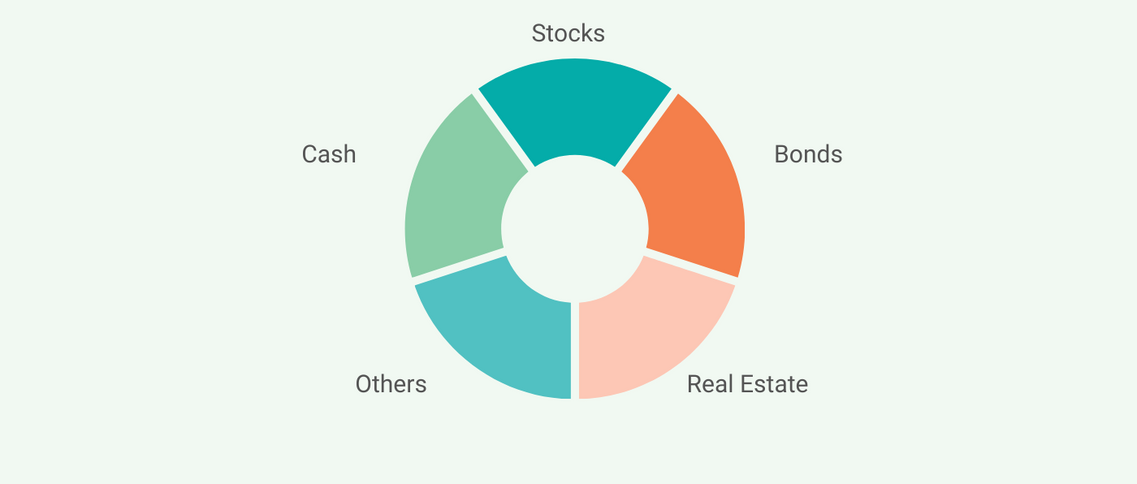
Asset allocation is the decision about how much of your money sits in stocks, how much in bonds, and how much in everything else. It is made before you pick a single ticker, and it sets the range of outcomes your portfolio can produce. This guide covers what asset allocation is, the main asset classes, how to choose an allocation, and how to keep one on track.
Key takeaways
- Asset allocation is the distribution of a portfolio across asset classes such as stocks, bonds, real estate, cash and alternatives, chosen to fit an investor's goals and risk tolerance.
- Asset allocation matters because asset classes respond differently to growth, inflation and interest rates, so mixing them limits the damage any single economic surprise can do.
- The five primary asset classes used in asset allocation are stocks, bonds, real estate, cash and cash equivalents, and alternative investments.
- An asset allocation is chosen from three inputs: the time horizon until you need the money, your tolerance for seeing the portfolio fall, and the return you need to reach your goal.
- Asset allocation drifts as markets move, so a portfolio set to 60% stocks and 40% bonds will not stay there without periodic rebalancing.
What is asset allocation?
Asset allocation is the distribution of an investment portfolio across different asset classes, chosen to fit an investor's financial goals and stay within their risk tolerance. Each asset class carries its own risk and return characteristics, so the mix determines how the portfolio behaves.
An asset allocation is expressed in percentages of total portfolio value. A portfolio described as "70/30" holds 70% of its value in stocks and 30% in bonds. Those percentages are the allocation; the individual securities inside each slice are a separate decision.
Asset allocation operates one level above stock picking. Choosing to hold 80% stocks rather than 40% changes the portfolio's expected return and its worst-case loss far more than swapping one large-cap stock for another. That is why allocation is normally settled first and security selection second.
What are the main asset classes?
The five primary asset classes are stocks, bonds, real estate, cash and cash equivalents, and alternative investments. Each behaves differently in a given economic environment, which is what makes combining them useful.
| Asset class | What it is | Typical role in an allocation |
|---|---|---|
| Stocks (equity) | Ownership in a company | Long-term growth, highest volatility |
| Bonds | Debt issued by governments or corporations | Income and ballast when stocks fall |
| Real estate | Physical property or REITs | Income plus some inflation sensitivity |
| Cash and equivalents | Money market funds, short-term CDs, Treasury bills | Liquidity and safety, lowest return |
| Alternatives | Commodities, hedge funds, private equity | Diversification beyond traditional markets |
Stocks (equity) are ownership in a company, classified by market capitalisation, listing market, industry and sector — large-cap, mid-cap, small-cap, emerging market and so on. Stocks carry the highest volatility of the primary asset classes and, historically, the highest long-run return.
Bonds are debt securities issued by governments or corporations, categorised by issuer, maturity and credit rating — corporate, government and municipal bonds among them. Bonds pay a defined stream of interest, which is why they are used to steady a portfolio that also holds stocks.
Real estate means physical property or Real Estate Investment Trusts (REITs), which give exposure to property markets without direct ownership. It typically generates rental income and responds to interest rates and inflation differently from stocks.
Cash and cash equivalents, such as money market funds or short-term certificates of deposit (CDs), provide liquidity and safety. Cash is what you draw on for near-term spending, though inflation erodes its purchasing power over time.
Alternative investments include hedge funds, private equity and commodities. Their returns are driven by different factors, which adds diversification, but they are usually less liquid, harder to value and higher risk.
Why is asset allocation important to investors?
Asset allocation is important because it determines both the return a portfolio can realistically produce and the loss its owner has to be able to sit through. Three reasons stand out.
Asset allocation fits individual needs. Investors have different goals and different levels of risk tolerance, so there is no one-size-fits-all portfolio. The same universe of stocks and bonds can be assembled into a portfolio suited to a 25-year-old saving for retirement or a 68-year-old already drawing an income from it.
Asset allocation balances risk and reward. Retirees often prioritise capital preservation over high returns, because they have limited years of earnings left to replace a loss. Younger investors with decades ahead can hold a higher share of stocks, since they have time to recover from a fall.
Asset allocation manages economic surprises. Rising inflation hurts long-dated bonds while commodities may benefit; a growth slowdown hurts stocks while government bonds often rally. Balancing assets by these structural characteristics limits the impact of any single economic surprise.
How do you choose an asset allocation?
An asset allocation is chosen from three inputs: your time horizon, your risk tolerance, and the return your goal actually requires. Work through them in that order, because the horizon constrains everything else.
- Time horizon. How many years until you need the money? A goal 25 years away can carry far more equity than one three years away, because there is time for a fall to reverse.
- Risk tolerance. How large a fall can you hold through without selling? An allocation you abandon in a downturn is worse than a more conservative one you keep.
- Required return. What return does your goal need? If a conservative allocation cannot get you there, the honest fix is usually saving more, not adding risk you cannot tolerate.
A common rule of thumb is to hold a percentage of stocks equal to roughly 110 minus your age, with the rest in bonds and cash. Treat it as a starting point rather than an answer: it knows nothing about your job security, other income, or how you behaved the last time markets fell.
Note that the number of individual securities you own is a separate question from allocation. Two portfolios can both be 80% stocks while one holds a single index fund and the other holds forty names, which is why how many stocks you should own is worth deciding on its own terms.
What are some examples of asset allocation models?
Well-known asset allocation models range from a simple stock-and-bond split to portfolios deliberately balanced across economic environments. Four are widely referenced.
| Model | Rough shape | Idea behind it |
|---|---|---|
| 60/40 | 60% stocks, 40% bonds | A long-standing default balance of growth and ballast |
| Buffett's 90/10 | 90% low-cost S&P 500 index fund, 10% short-term government bonds | Maximum equity exposure with a small liquidity buffer |
| Three-fund portfolio | Domestic stocks, international stocks, bonds | Broad global coverage in three low-cost funds |
| All Weather | Stocks, long and intermediate bonds, gold and commodities | Balanced so no single economic environment dominates |
Ray Dalio's All Weather Portfolio
The All Weather Portfolio is an asset allocation designed so that no single economic environment — inflation, deflation, growth or contraction — dominates the portfolio's outcome. It spreads capital across stocks, long-dated and intermediate bonds, gold and commodities, weighted by how each responds to those environments rather than by expected return.
"Launched in 1996, All Weather was originally created for Ray's trust assets. It is predicated on the notion that asset classes react in understandable ways based on the relationship of their cash flows to the economic environment. By balancing assets based on these structural characteristics the impact of economic surprises can be minimized. Market participants might be surprised by inflation shifts or a growth bust and All Weather would chug along, providing attractive, relatively stable returns." - Bridgewater Research & Insights
Warren Buffett's 90/10 Investing Strategy
Warren Buffett's 90/10 strategy is an asset allocation of 90% in a low-cost S&P 500 index fund and 10% in short-term government bonds, which he set out in the 2013 Berkshire Hathaway annual report as the instruction for a trust left to his wife.
"My money, I should add, is where my mouth is: What I advise here is essentially identical to certain instructions I've laid out in my will. One bequest provides that cash will be delivered to a trustee for my wife's benefit. (I have to use cash for individual bequests, because all of my Berkshire shares will be fully distributed to certain philanthropic organizations over the ten years following the closing of my estate.) My advice to the trustee could not be more simple: Put 10% of the cash in short-term government bonds and 90% in a very low-cost S&P 500 index fund. (I suggest Vanguard's.) I believe the trust's long-term results from this policy will be superior to those attained by most investors – whether pension funds, institutions or individuals – who employ high-fee managers." - Berkshire Hathaway 2013 Annual Report
How does an asset allocation drift, and when should you rebalance?
An asset allocation drifts because asset classes grow at different rates, so the winners quietly take up more of the portfolio than you chose. A portfolio set to 60% stocks and 40% bonds becomes roughly 65/35 after a year in which stocks rise 20% and bonds are flat — a riskier portfolio than the one you signed up for.
Rebalancing is the act of selling what has grown past its target and buying what has fallen below it, returning the portfolio to its intended allocation. Two conventions are common:
- Calendar rebalancing. Check and reset the allocation on a fixed schedule, such as annually or semi-annually.
- Threshold rebalancing. Reset only when an asset class drifts more than a set band, commonly 5 percentage points, away from its target.
Rebalancing has a cost: every trade carries fees, and selling appreciated positions in a taxable account realises capital gains. Frequent resets therefore raise portfolio turnover, which drags on after-tax returns, so most long-term investors rebalance no more than once or twice a year. Our free portfolio rebalancing calculator works out the trades needed to return a portfolio to its target weights.
The prerequisite for rebalancing is knowing your current allocation, which is harder than it sounds when holdings sit at three brokers in two currencies. Portseido consolidates holdings across brokers and currencies and shows the asset allocation breakdown of the combined portfolio, so the drift is visible without maintaining a spreadsheet.
What is the difference between asset allocation and diversification?
Asset allocation decides how much goes into each asset class; diversification decides how widely you spread the money inside each class. They are related but not the same decision.
| Asset allocation | Diversification | |
|---|---|---|
| Question it answers | How much in stocks vs bonds vs cash? | How many holdings, across which sectors and regions? |
| Level it works at | Asset class | Individual security |
| Main risk it addresses | Exposure to one type of asset | Exposure to one company or sector |
A portfolio can be well allocated and badly diversified at the same time: 70% stocks and 30% bonds looks reasonable until you find the entire equity slice sits in three semiconductor companies. Checking the portfolio weight of every position alongside the asset class split is what catches that.
Frequently asked questions
Does asset allocation change with age?
Yes, for most investors. As the time horizon to a goal shortens, the ability to recover from a large fall shrinks, so the share held in stocks is usually reduced in favour of bonds and cash. Target-date funds automate this by following a preset glide path, moving from stock-heavy to bond-heavy as the target year approaches.
How many asset classes do I need in a portfolio?
Two are enough to constitute an asset allocation: stocks and bonds, which is what the classic 60/40 portfolio holds. Adding real estate, commodities or cash can smooth returns further, but each addition brings complexity and often higher fees. Most individual investors are well served by two to four asset classes they actually understand.
Does asset allocation apply to a portfolio held across several brokers?
Yes. Asset allocation is a property of your total wealth, not of any one account, so a 60/40 target only means something when every account is counted together. An investor holding bonds at one broker and stocks at another may be far from their target allocation while each individual account looks reasonable, which is one of the real costs of holding multiple investment accounts.
Is cash part of an asset allocation?
Cash is a genuine asset class within an asset allocation, not just uninvested money. It provides liquidity for near-term spending and a buffer that avoids forced selling during a downturn. Its cost is real: cash typically returns less than inflation over long periods, so a large permanent cash allocation reduces long-run purchasing power.
How to track asset allocation in Portseido
Portseido is a portfolio tracker that shows the asset allocation of your whole portfolio, not one account at a time. It consolidates holdings across multiple brokers and currencies, breaks the combined portfolio down by allocation, tracks cost basis, dividends and yield on cost, calculates time-weighted and money-weighted returns, and reports drawdown so you can see what a given allocation actually put you through. You can import transactions from brokers or from a CSV, and benchmark the result against indices and ETFs.
It suits self-directed investors whose money is spread across more than one platform. Portseido tracks and reports on your portfolio; it does not give buy or sell recommendations or set an allocation for you. There is a free plan, and paid features come with a 14-day trial that does not need a credit card. Try Portseido free