

What is Ex-Dividend Date?
Article last updated: September 10, 2026

Every dividend runs through a fixed sequence of four dates, and the ex-dividend date is the one that decides who gets paid. Get the sequence right and dividend eligibility stops being mysterious: it is a cutoff, not a reward for holding, and the market prices it in the moment it passes.
Key takeaways
- The ex-dividend date is the first day on which a stock trades without the right to the upcoming dividend, so a buyer on or after that date does not receive the payment.
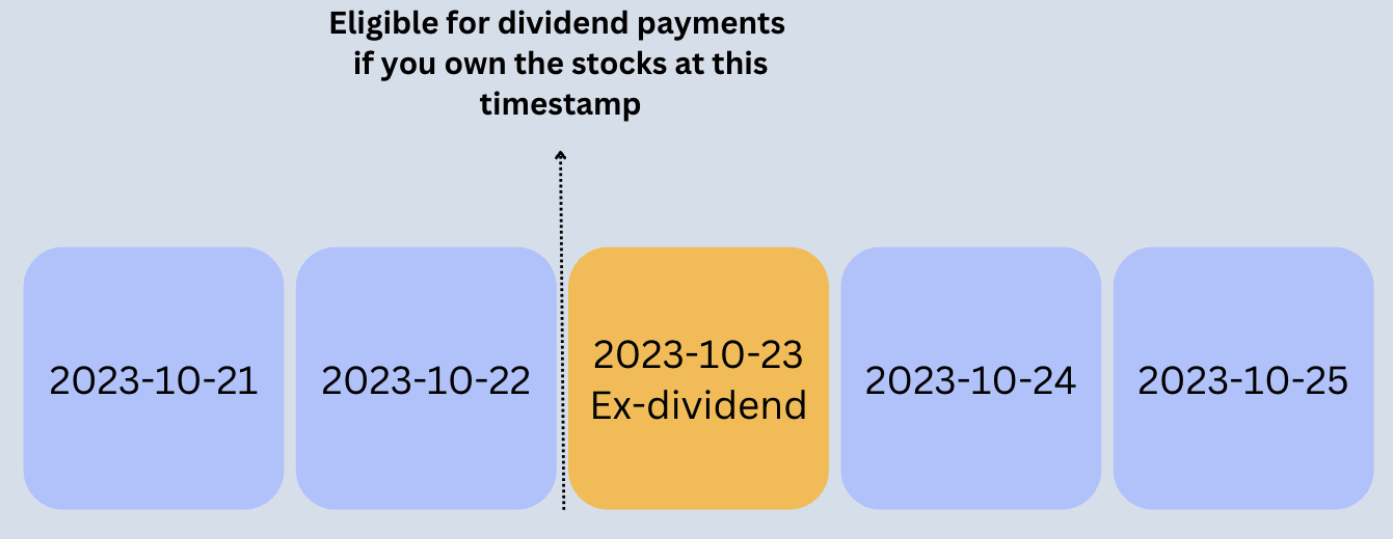
- To receive a dividend you must own the shares before the ex-dividend date; buying on the ex-dividend date itself is too late.
- Selling shares on or after the ex-dividend date still entitles you to the dividend, because eligibility was fixed at the market open on that date.
- A stock's price typically falls by roughly the dividend amount at the open on the ex-dividend date, which is why buying just before it does not create free income.
- The four dividend dates run in order: declaration date, ex-dividend date, record date, payment date.
What is the ex-dividend date?
The ex-dividend date is the first date on which a stock trades without the right to the upcoming dividend payment. A stock is described as trading "ex-dividend" from that date until the dividend is paid.
The rule for an investor is simple: to receive a declared dividend, you must own the stock before the ex-dividend date. Buy on the ex-dividend date or later and the dividend goes to the person who sold to you, no matter how long you subsequently hold.
The ex-dividend date exists because share ownership changes hands constantly and a company needs one unambiguous cutoff for who is entitled to a payment. Setting that cutoff by trade date, rather than by who happens to be on the register on any given afternoon, makes eligibility deterministic for every buyer and seller.
What are the four dividend dates, in order?
Every dividend follows the same four-date sequence: declaration date, ex-dividend date, record date, and payment date. Each date has a distinct job.
| # | Date | What happens |
|---|---|---|
| 1 | Declaration date | The company's board announces the dividend, its amount, and the record and payment dates |
| 2 | Ex-dividend date | The stock begins trading without the right to the dividend; buyers from this date on do not receive it |
| 3 | Record date | The company closes the books and identifies the registered shareholders entitled to the dividend |
| 4 | Payment date | The company disburses the dividend into entitled shareholders' accounts |
Each in full:
- Declaration date. The declaration date is the day a company's board of directors formally announces an upcoming dividend. The announcement states the dividend per share and the record and payment dates, which creates a legal obligation for the company to pay it.
- Ex-dividend date. The ex-dividend date is the first day the stock trades without the right to that dividend. Ownership must be established before this date to qualify.
- Record date. The record date is the day the company closes the book on who is entitled to the dividend, by taking a snapshot of its shareholder register. The gap between the ex-dividend date and the record date exists so that trades have time to settle. Under a two-day settlement cycle (T+2) the ex-dividend date falls one business day before the record date; under a one-day cycle (T+1), which US markets adopted in May 2024, the ex-dividend date and the record date fall on the same day.
- Payment date. The payment date is when the company actually disburses the dividend to entitled shareholders. This is the day the cash appears in your brokerage account, typically two to five weeks after the record date.
Will I get the dividend if I buy on the ex-dividend date?
No. Buying a stock on the ex-dividend date does not entitle you to the upcoming dividend, because the ex-dividend date is the first day the stock trades without that right. You must have owned the shares before the ex-dividend date.
The last day to buy and still qualify is therefore the trading day immediately before the ex-dividend date. There is no minimum holding period for eligibility itself: buying the day before the ex-dividend date and selling the day after still collects the dividend.
Will I get the dividend if I sell on the ex-dividend date?
Yes. If you owned the stock before the ex-dividend date and sell it on or after that date, you still receive the upcoming dividend. Entitlement was fixed at the market open on the ex-dividend date and does not travel with the shares afterwards.
This feels counterintuitive, because the cash arrives on the payment date weeks later, by which point you may no longer be a shareholder. It is deliberate. Pinning entitlement to a single cutoff means every buyer and seller knows in advance which side of the trade the dividend belongs to, and the share price reflects that from the ex-dividend date onward.
Do stocks fall on the ex-dividend date?
Yes. A stock's price typically opens lower on the ex-dividend date by approximately the amount of the dividend, because the shares no longer carry the right to that payment. A company that declares a $1 dividend has $1 per share less in assets once it commits to paying it, and buyers from the ex-dividend date on do not receive the $1.
This adjustment is why timing a purchase around the ex-dividend date does not manufacture income. Buy the day before at $50 and you get a $1 dividend on a stock now worth about $49. Buy on the ex-dividend date at about $49 and you keep the extra dollar of purchase price. Either way you hold roughly $50 of value.
The observed drop is approximate rather than exact. Normal trading moves the price on the same day, and in markets where dividends are taxed more heavily than capital gains the drop is often slightly smaller than the full dividend. The adjustment is a strong tendency, not an arithmetic guarantee.
It also explains why the dividend yield quoted on a stock is not a bonus on top of the share price. The yield is funded out of the company's assets, and the market marks the price down for it on every ex-dividend date.
Is it better to sell before or after the ex-dividend date?
Selling before or after the ex-dividend date usually makes little material difference, because the share price falls by roughly the dividend at the open on the ex-dividend date. Sell before and you get a higher price; sell after and you get a lower price plus the dividend.
Two things can break the tie:
- Tax. In many jurisdictions dividend income and capital gains are taxed at different rates, and an investor's own bracket or account type decides which is preferable. Holding in a tax-sheltered account often removes the distinction entirely.
- Income planning. An investor living off portfolio income may value the cash payment itself, independently of total return.
The strategy of buying shortly before the ex-dividend date purely to collect the payment, then selling shortly after, is known as dividend capture. It is unreliable for exactly the reason above: the expected gain is roughly cancelled by the price adjustment, while trading costs and tax are certain. Long-term dividend investors generally ignore the ex-dividend calendar altogether and focus on whether the dividend itself is well covered, which is what the dividend payout ratio measures.
Frequently asked questions
How long do I have to hold a stock to get its dividend?
For eligibility, only until the market close on the day before the ex-dividend date. There is no minimum holding period to receive a declared dividend. Tax treatment is a separate matter: in the United States, a dividend is only a qualified dividend, taxed at the lower long-term rate, if the shares were held for more than 60 days within the 121-day window around the ex-dividend date.
Who sets the ex-dividend date?
The stock exchange or the relevant market regulator sets the ex-dividend date, not the company. The company's board declares the dividend amount, the record date and the payment date; the exchange then derives the ex-dividend date from the record date using the market's settlement cycle. This is why the ex-dividend date is announced alongside, rather than by, the company.
What happens if I buy before the ex-dividend date but the trade settles after it?
You still receive the dividend. Ex-dividend eligibility is determined by trade date, not settlement date, which is the entire purpose of placing the ex-dividend date ahead of the record date by the length of the settlement cycle. Your broker handles the settlement mechanics; the dividend follows the trade date.
Does a dividend reinvestment plan change the ex-dividend date rules?
No. A dividend reinvestment plan changes only what happens to the cash after the payment date, converting it into additional shares instead of a cash balance. Eligibility still depends on owning the shares before the ex-dividend date. Reinvested shares purchased after an ex-dividend date do not retroactively qualify for that dividend.
Do ETFs have ex-dividend dates?
Yes. Exchange-traded funds that distribute income have the same four-date sequence as individual stocks, including an ex-dividend date. The fund collects dividends from its underlying holdings throughout the period and distributes them on its own schedule, most commonly quarterly or monthly, with an ex-dividend date set the same way.
How to track dividend dates and payments in Portseido
Reconciling which dividends you were actually entitled to, across several brokers and currencies, is the part of dividend investing that quietly eats time. Portseido records every dividend you receive and builds a dividend income history for each holding, so payments are matched to positions without manual bookkeeping, and it reports dividend yield and yield on cost from that same record. The dividend tracking features include a dividend calendar and projected income alongside the payment history.
It suits investors holding income-paying stocks and ETFs at more than one broker who want a single view of what was paid and when. Portseido tracks and reports on your portfolio; it does not give buy or sell recommendations. There is a free plan, and paid features come with a 14-day trial that does not need a credit card. Try Portseido free